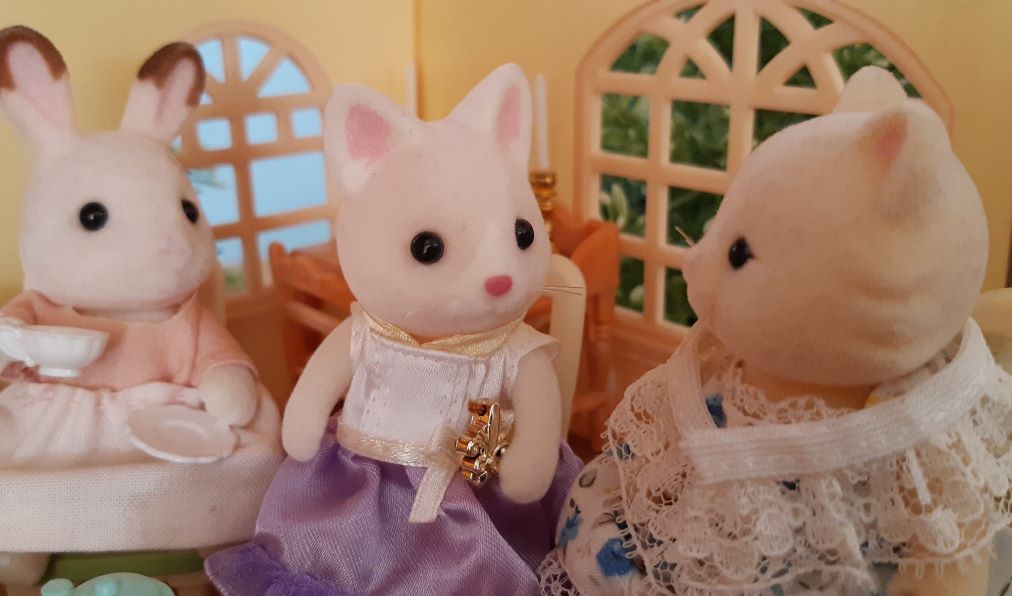
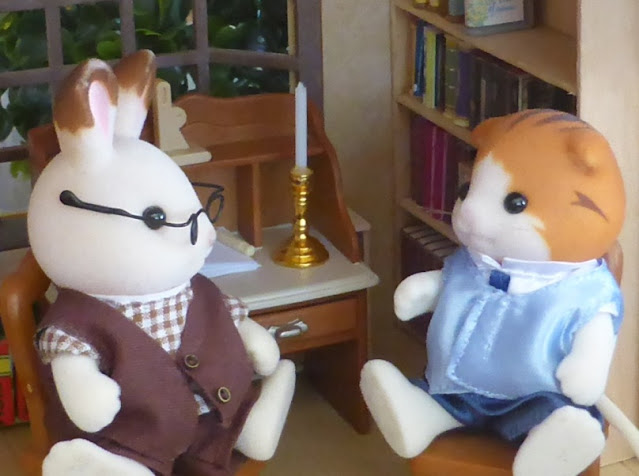
Showing posts with label Adapted Stories. Show all posts

Sunday, 9 June 2024

Sylvanian Pride and Prejudice - Part Four

Here is the latest instalment of my long-term project, to cast and photograph Jane Austen's novel, Pride and Prejudice, using Sylvanian Families.  A bit more story this time!

If you missed the earlier parts, I recommend reading Part One first.  (I also highly recommend seeking out Austen's original book and reading it - it is great fun!).

Obviously, the words that follow are not my own, although I have heavily abridged the original text.  I do hope you enjoy it.

~ ~ ~ ~ ~ ~ ~ ~ ~ ~ ~ ~ ~ ~ ~ ~ ~ ~ ~ ~ ~ ~ ~ ~ ~ ~ ~ ~ ~ ~ ~ ~ ~ ~ ~ ~ ~ ~ ~ ~ ~ ~ ~ ~ ~ ~ ~ ~ ~ ~ ~ ~ ~

The village of Longbourn was only one mile from Meryton;  a most convenient distance for the young ladies, who were usually tempted thither three or four times a week, to pay their duty to their aunt, who had married a Mr Philips, and also to a milliner’s shop just over the way.

The two youngest of the family, Catherine and Lydia, were particularly frequent in these attentions;  their minds were more vacant than their sisters’, and a walk to Meryton was necessary to amuse their morning hours and furnish conversation for the evening.  At present, they were well supplied with news and happiness by the recent arrival of a militia regiment in the neighbourhood;  it was to remain the whole winter, and Meryton was the headquarters.

Their visits to Mrs Philips were now productive of the most interesting intelligence.  Every day added something to their knowledge of the officers’ names and connections.  At length they began to know the officers themselves, and they could talk of nothing else.

After listening one morning to their effusions on this subject, Mr Bennet coolly observed,

“From all that I can collect by your manner of talking, you must be two of the silliest girls in the country.  I have suspected it some time, but I am now convinced.”

Catherine was disconcerted, and made no answer;  but Lydia, with perfect indifference, continued to express her admiration of Captain Carter.

“I am astonished, my dear,” said Mrs Bennet, “that you should be so ready to think your own children silly.  They are all of them very clever.  I remember the time when I liked a red coat myself very well – and indeed so I do still at my heart;  and if a smart young colonel, with five or six thousand a year, should want one of my girls, I shall not say nay to him.”

Mr Bennet was prevented replying by the entrance of the footman with a note for Miss Bennet;  it came from Netherfield, and the servant waited for an answer.  

Mrs Bennet’s eyes sparkled with pleasure and she was eagerly calling out, while her daughter read, “Well Jane, who is it from?  What does he say?  Make haste and tell us.”

“It is from Miss Bingley,” said Jane.  “She asks me to dine with her and her sister.  The gentlemen are to dine with the officers.”

“Dining out,” said Mrs Bennet, “that is very unlucky.”

“Can I have the carriage?” said Jane.

“No, my dear, you had better go on horseback, because it seems likely to rain;  and then you must stay all night.”

Jane was therefore obliged to go on horseback, and her mother’s hopes were answered;  Jane had not been gone long before it rained hard.  

Her sisters were uneasy for her, but her mother was delighted.  The rain continued all evening without intermission;  Jane certainly could not come back.

“This was a lucky idea of mine, indeed!” said Mrs Bennet, more than once.  

The next morning, however, breakfast was scarcely over when a servant from Netherfield brought the following note for Elizabeth:

‘My dearest Lizzy,

I find myself very unwell this morning, which I suppose is to be imputed to my getting wet through yesterday.  My kind friends will not hear of my returning home till I am better.  They insist also on my seeing Mr Jones – but do not be alarmed – excepting a sore throat and head-ache there is not much the matter with me.

Yours, &c.’

“Well, my dear,” said Mr Bennet, “if your daughter should have a dangerous fit of illness, if she should die, it would be a comfort to know that it was all in pursuit of Mr Bingley, and under your orders.”

“Oh!  People do not die of little trifling colds.  She will be taken good care of.  As long as she stays there, it is all very well.”

Elizabeth, feeling really anxious, was determined to go to her sister, and declared her resolution to walk there.

She set off, crossing field after field at a quick pace, jumping over stiles and springing over puddles, finding herself at last within view of the house, with weary ancles, dirty stockings, and a face glowing with the warmth of exercise.

She was shewn into the breakfast-parlour, where her appearance created but a great deal of surprise.  

That she should have walked three miles so early in the day, in such dirty weather, and by herself, was almost incredible to Mrs Hurst and Miss Bingley, and Elizabeth was convinced that they held her in contempt for it.

Her enquiries after her sister were not very favourably answered.  Miss Bennet had slept ill, and was very feverish and not well enough to leave her room.  

Elizabeth was glad to be taken to her immediately, and Jane was delighted at her entrance.   She was not equal however to much conversation, and could attempt little beside expressions of gratitude for the kindness she was treated with Elizabeth silently attended her.   

The apothecary came, and having examined his patient, said that she had caught a violent cold, and that they must endeavour to get the better of it, advised her to return to bed, and promised her some draughts.

The advice was followed readily, for the feverish symptoms increased, and her head ached acutely.  Elizabeth did not quit her room for a moment.

When the clock struck three, Elizabeth felt that she must go, and very unwillingly said so.  Jane testified such concern in parting with her, that Miss Bingley was obliged into an invitation for her to remain at Netherfield for the present.  Elizabeth most thankfully consented.

~~~ o ~~~


Saturday, 27 April 2024

Sylvanian Pride and Prejudice - Part Three

For those who do not know, it has been a long-term project of mine for to cast and photograph Jane Austen's novel, Pride and Prejudice, using Sylvanian Families.  I am sorry it has been so long since the last instalment - sometimes real life gets in the way!

Anyway, here is Part Three - just a short one this time, but I promise the next part will not be too far away (and will get into the story a little more than this one does!)

If you missed the earlier parts, I recommend reading Part One first.  (I also highly recommend seeking out Austen's original book and reading it - it is great fun!).

Obviously, the words that follow are not my own, although I have heavily abridged the original text.  I do hope you enjoy it.

~ ~ ~ ~ ~ ~ ~ ~ ~ ~ ~ ~ ~ ~ ~ ~ ~ ~ ~ ~ ~ ~ ~ ~ ~ ~ ~ ~ ~ ~ ~ ~ ~ ~ ~ ~ ~ ~ ~ ~ ~ ~ ~ ~ ~ ~ ~ ~ ~ ~ ~ ~ ~

The ladies of Longbourn soon waited on those of Netherfield.  

The visit was returned in due form.  

Miss Bennet’s pleasing manners grew on the good will of Mrs Hurst and Miss Bingley;  and though the mother was found to be intolerable and the younger sisters not worth speaking to, a wish of being better acquainted with them, was expressed towards the two eldest.    

By Jane this attention was received with the greatest pleasure;  but Elizabeth still saw superciliousness in their treatment of every body, and could not like them. 

It was generally evident whenever they met Mr Bingley, that he did admire Jane...

... and to Elizabeth it was equally evident that Jane was in a way to be very much in love.  She considered with pleasure that it was not likely to be discovered by the world in general, since Jane united with great strength of feeling, a composure of temper which would guard her from the suspicions of the impertinent.

Occupied in observing Mr Bingley’s attentions to her sister, Elizabeth was far from suspecting that she was herself becoming an object of some interest in the eyes of his friend.  

Mr Darcy had at first scarcely allowed her to be pretty.  But no sooner had he made it clear to himself and his friends that she had hardly a good feature in her face, than he began to find it was rendered uncommonly intelligent by the beautiful expression of her dark eyes.  


Of this she was perfectly unaware; - to her he was only the man who made himself agreeable no where.


~~~ o ~~~


Ready for more Pride and Prejudice?  Click here for Part Four...

Sunday, 9 January 2022

Sylvanian Pride and Prejudice - Part Two

For those who do not know, it has been an ambition of mine for some time to cast and photograph Jane Austen's delightful Pride and Prejudice, using Sylvanian Families.  This is Part Two of that endeavour - I do plan to post instalments from time to time when I can, and have great hopes of eventually getting through the whole story!

If you missed Part One, I recommend reading that first.  (I also highly recommend seeking out Austen's original book and reading it - it is great fun!  Many people do not realise how much writers such as Austen have influenced modern romantic comedies).

Obviously, the words that follow are not my own, although I have heavily abridged the original text to come up with this version.  I hope you enjoy it.

~ ~ ~ ~ ~ ~ ~ ~ ~ ~ ~ ~ ~ ~ ~ ~ ~ ~ ~ ~ ~ ~ ~ ~ ~ ~ ~ ~ ~ ~ ~ ~ ~ ~ ~ ~ ~ ~ ~ ~ ~ ~ ~ ~ ~ ~ ~ ~ ~ ~ ~ ~ ~

In a few days, Mr Bingley returned Mr Bennet’s visit, and sat about ten minutes with him in his library.  He had entertained hopes of being admitted to a sight of the young ladies, of whose beauty he had heard much, but he saw only the father. 

An invitation to dinner was soon afterwards dispatched, but an answer arrived which deferred it all.  Mr Bingley was obliged to be in town the following day, and consequently unable to accept their invitation.  Mrs Bennet was quite disconcerted, however Lady Lucas quieted her fears – her report of Mr Bingley was highly favourable.  He was quite young, handsome, extremely agreeable, and to crown the whole, he meant to be at the next assembly with a large party.  Nothing could be more delightful!

When the party entered the assembly room, it consisted of five altogether;  Mr Bingley, his two sisters, the husband of the eldest, and another young man.

Mr Bingley was good looking and gentlemanlike, with easy, unaffected manners.  His sisters were fine women, with an air of decided fashion.  His brother in law, Mr Hurst, merely looked the gentleman, but his friend Mr Darcy soon drew the attention of the room by his fine, tall person, handsome features, noble mien, and the report which was immediately in general circulation, of his having ten thousand a year. 

He was looked at with great admiration for about half the evening, till his manners turned the tide of his popularity, for he was discovered to be proud, to be above his company, and above being pleased.

Mr Bingley was lively and unreserved, danced every dance, and talked of giving a ball himself at Netherfield.  

What a contrast between him and his friend!  Mr Darcy danced only once with Mrs Hurst and once with Miss Bingley, and declined being introduced to any other lady.  His character was decided.  He was the proudest, most disagreeable man in the world, and every body hoped that he would never come there again.  Among the most violent against him was Mrs Bennet, as he had slighted one of her daughters.

Elizabeth Bennet had been obliged, by the scarcity of gentlemen, to sit down for two dances, and during part of that time, Mr Darcy had been standing near.  Bingley came from the dance for a few minutes, to press his friend to join it.

“Come Darcy,” said he, “I hate to see you standing about in this stupid manner.  You had much better dance.”

“I certainly shall not.  You know how I detest it, unless I am particularly acquainted with my partner.  At such an assembly as this, it would be insupportable.”

“I would not be so fastidious as you are,” cried Bingley, “for a kingdom!  Upon my honour, I never met with so many pleasant girls in my life, and there are several of them uncommonly pretty.”

“You are dancing with the only handsome girl in the room,” said Mr Darcy, looking at the eldest Miss Bennet.

“Oh!  she is the most beautiful creature I ever beheld!  But there is one of her sisters sitting down just behind you, who is very pretty, and I daresay very agreeable.”

“Which do you mean?” and turning round, he looked for a moment at Elizabeth, then coldly said, “She is tolerable, but not handsome enough to tempt me, and I am in no humour at present to give consequence to young ladies who are slighted by other men.  You had better return to your partner and enjoy her smiles, for you are wasting your time with me.”

Mr Bingley followed his advice.  Mr Darcy walked off, and Elizabeth remained with no very cordial feelings toward him.  She told the story however with great spirit among her friends, for she had a lively, playful disposition. 

The evening altogether passed off pleasantly to the whole family.  They returned therefore in good spirits to Longbourn.  They found Mr Bennet still up.  

He had rather hoped that all his wife’s views on the stranger would be disappointed, but he soon found that he had a very different story to hear.

“Oh!  my dear Mr Bennet, we have had a most delightful evening.  Jane was so admired, nothing could be like it.  Mr Bingley thought her quite beautiful and danced with her twice.  Only think of that, my dear, he actually danced with her twice, and she was the only creature in the room that he asked a second time.  Oh!  I am quite delighted with him.  He is so excessively handsome!  and his sisters are such charming women.  I never in my life saw any thing more elegant than their dresses-“

Here she was interrupted.  Mr Bennet protested against any description of finery.  She therefore related, with much bitterness of spirit and some exaggeration, the shocking rudeness of Mr Darcy.

“Another time, Lizzy, I would not dance with him, if I were you.”

“I believe, Ma’am,” replied Elizabeth, “I may safely promise you never to dance with him.”


~~~ o ~~~


When Jane and Elizabeth were alone, the former, who had been cautious in her praise of Mr Bingley before, expressed to her sister how very much she admired him.

“He is just what a young man ought to be,” said she.  “I was very much flattered by his asking me to dance a second time.  I did not expect such a compliment.”

“Did not you?” replied Elizabeth.  “I did for you.  He could not help seeing that you were about five times as pretty as every other woman in the room, and you never see a fault in any body.  All the world are good and agreeable in your eyes.  Well, he certainly is very agreeable, and I give you leave to like him.  And so, you like this man’s sisters too, do you?  Their manners are not equal to his.”

“Certainly not at first.  But they are very pleasing women when you converse with them.  Miss Bingley is to live with her brother and keep his house, and I am much mistaken if we shall not find a very charming neighbour in her.”

Elizabeth listened in silence, but was not convinced.  With more quickness of observation, and less pliancy of temper than her sister, she was very little disposed to approve them.
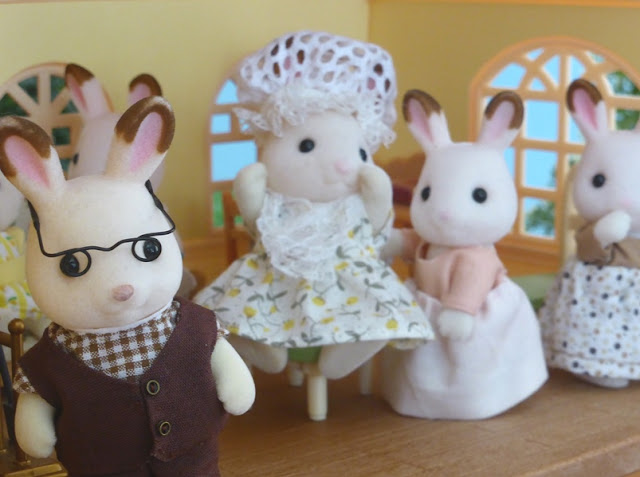
The manner in which the Netherfield party spoke of the Meryton assembly was sufficiently characteristic.  Bingley had never met with pleasanter people in his life;  every body had been most kind and attentive to him;  and as to Miss Bennet, he could not conceive an angel more beautiful. 

Darcy, on the contrary, had seen a collection of people in whom there was little beauty and no fashion, and for none of them he had felt the smallest interest.  Miss Bennet he acknowledged to be pretty, but she smiled too much.

Mrs Hurst and her sister allowed it to be so – but still they admired her and liked her, pronounced her a sweet girl, and one whom they should not object to know more of.  Their brother therefore felt authorised by such commendation to think of her as he chose.


~~~ o ~~~

Ready for more Pride and Prejudice?  Click here for Part Three...


Sunday, 10 October 2021

Sylvanian Pride and Prejudice - Part One

This is something I have been wanting to do for a long time.  Caitlyn and I both love Jane Austen's Pride and Prejudice, and the notion of casting Sylvanians in all the roles, and photographing them to illustrate the story, was just too tempting!  It is destined to be a very time-consuming endeavour, what with all the costumes that will need to be made (ball gowns!  regimentals!), so I do not promise to finish it quickly.  I do plan to post instalments from time to time when I can, and have great hopes of eventually getting through the whole story!

Obviously, the words are not my own, although this is very much an abridged version of Austen's masterpiece.  I have also made some slight additions where necessary to tie the photos in (these will be kept to a minimum though.  I am hoping it mightn't be necessary again at all after this first instalment).

Without further ado, I would like to present Part One of my Sylvanian Pride and Prejudice - I do hope you enjoy it, and that it inspires you to seek out the original book and read it if you have not done so already!

*************************************************************************************

It is a truth universally acknowledged, that a single man in possession of a good fortune, must be in want of a wife.

“My dear Mr Bennet,” said his lady to him one day, as the family walked home from church, “have you heard that Netherfield Park is let at last?”

Mr Bennet replied that he had not.

“But it is,” returned she.  “Netherfield is taken by a young man named Bingley – a single man of large fortune, four or five thousand a year.  What a fine thing for our girls!”

“How so?  How can it affect them?”

“My dear Mr Bennet,” replied his wife, “how can you be so tiresome?  You must know that I am thinking of his marrying one of them.”

“Is that his design in settling here?”

“Design!  Nonsense, but it is very likely that he may fall in love with one of them, and therefore you must visit him as soon as he comes.”

“I see no occasion for that...” Mr Bennet began.

Their eldest daughters, Jane and Elizabeth, shared a rueful smile.

Mary followed next, her mind on what she considered loftier matters, and behind her came the two youngest Bennets, Kitty and Lydia, giggling and chattering excitedly.

By this time they had arrived home, and despite Jane’s ministrations, Mrs Bennet was in quite a state.


“But consider your daughters," said she.  "Indeed you must go, for it will be impossible for us to visit him, if you do not.  Oh, you delight in vexing me.  You have no compassion on my poor nerves.”

“You mistake me, my dear.  I have a high respect for your nerves," replied Mr Bennet.  "I have heard you mention them with consideration these twenty years at least.  But I hope you will get over it, and live to see many young men of four thousand a year come into the neighbourhood.”

“It will be no use to us, if twenty such should come since you will not visit them.”

“Depend upon it my dear, that when there are twenty, I will visit them all.”


~~~ o ~~~

It was a few days later, and Mr Bennet made some casual mention of Mr Bingley, wondering whether or not the intriguing new visitor would like some trifling thing or other.

“We are not in a way to know what Mr Bingley likes,” said his wife resentfully, “since we are not to visit.”  Unable to contain herself, she began scolding one of her daughters.

“Don’t keep coughing so, Kitty, for heaven’s sake!  Have a little compassion on my nerves."

“I do not cough for my own amusement,” replied Kitty fretfully.

“Let us return to Mr Bingley,” Mr Bennet said.

“I am sick of Mr Bingley,” cried his wife.

“I am sorry to hear that, but why did not you tell me so before?  

If I had known as much this morning, I certainly would not have called on him.  It is very unlucky, but as I have actually paid the visit, we cannot escape the acquaintance now.”

The astonishment of the ladies was just what he wished, that of Mrs Bennet perhaps surpassing the rest.

“How good it was in you, my dear Mr Bennet!  I was sure you loved your girls too well to neglect such an acquaintance.  Well, how pleased I am!  And it is such a good joke, too, that you should have gone this morning, and never said a word about it till now.”

“Now, Kitty, you may cough as much as you chuse,” said Mr Bennet, and left the room, fatigued with the raptures of his wife.

“What an excellent father you have, girls,” said she.  “Lydia, my love, though you are the youngest, I dare say Mr Bingley will dance with you at the next ball.”

“Oh!” said Lydia stoutly, “I am not afraid, for though I am the youngest, I’m the tallest.”

~~~ o ~~~

Ready for more Pride and Prejudice?  Click here for Part Two...